Volleyball practice planner
Coach
Build a practice around better first contacts.
An AI agent for youth volleyball coaches. Help your players connect the first pass to what happens next. Coach organizes serving, passing and rally-building activities into a session with clear roles, repeatable cues and room to adjust.
$19 / month Cancel anytime
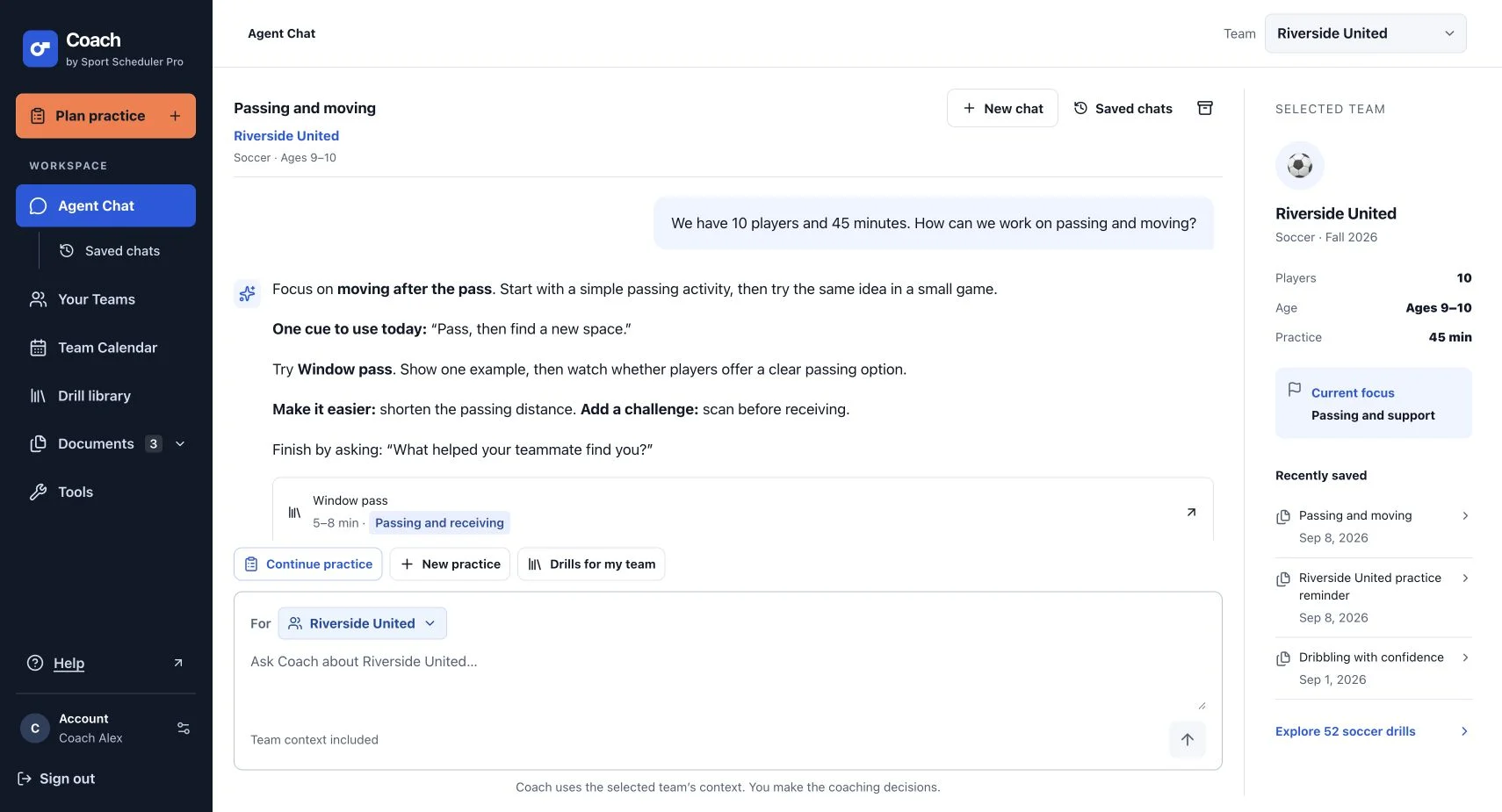
- Serving, passing, setting and cooperative rally activities
- Catch-and-reset options for players learning the contacts
- Court, net and group-size requirements on each drill
A PRACTICE YOU CAN START FROM
A first pass your teammate can use
A 45-minute volleyball session for six players ages 13–18. Pair contacts progress to trios and a cooperative 3v3 rally.
- Sport
- Volleyball
- Time
- 45 minutes
- Group
- 6 players
- Equipment
- 3 light, appropriate practice volleyballs; 1 secured volleyball net; 8 cones; A marked volleyball court with clear run-off and overhead space
Set up: Use three separated pair areas away from the net, then two trio areas. For serving and the final game, use the marked court. Keep only the named ball or group active and clear stray balls before restarting.
Make a plan for your team- 0–5minutes
Progressive walking warm-up
Walk a clear route at a comfortable pace, gradually increasing it if appropriate. Confirm the stop signal for a stray ball before starting contacts.
- 5–13minutes
Partner forearm passing to a moving target
Partners start 3–4 metres apart. Toss gently, move the feet and send a controlled forearm pass to a chest-height catching target. Swap after six attempts.
Try this cue: “Make the next touch easy.”
- 13–21minutes
Serve to short and deep zones
Mark two broad landing bands. One server chooses a comfortable starting distance and a target, then serves with control. Let the ball land before collection and rotate after three attempts.
Try this cue: “Choose the area before the serve.”
- 21–23minutes
Water and trio setup
Offer water and form two triangles. Name passer, setter and catcher before introducing the contact sequence.
- 23–31minutes
Pass, set, catch
A catcher feeds the passer, who sends to a calling setter. The setter directs a comfortable contact back to the catcher. Rotate all roles after three repetitions.
Try this cue: “Call early and give your partner time.”
- 31–40minutes
Cooperative three-contact volleyball
Play 3v3 from a gentle underhand send. Try pass, set and a controlled standing send; allow a catch when needed. Rotate first-contact responsibility and stop for crossed paths.
Try this cue: “Keep the rally playable for both sides.”
- 40–45minutes
Cool-down walk and check-in
Finish with an easy walk. Ask which first pass gave the setter the most time, and keep that observation for the next session.
Make it easier
Keep the target still, shorten the toss and allow a catch before the second contact. Start rallies with catches on every contact, then remove one when the group is ready.
Add a challenge
Move the target before the toss so the passer looks first. Alternate broad serving targets and gradually remove catches while keeping sends controlled.
Use controlled standing sends, with no diving or maximum jumps in this sample. For children under 13, choose the catalog’s toss-and-catch, forearm-pass-and-catch and mini-volleyball progressions rather than assuming this session fits unchanged.
SEE COACH IN ACTION
From your first question
to a plan you can share.
See Agent Chat, drill references, editable practices, your team calendar and messages to parents in a short narrated walkthrough.
Recorded with a sample team and demonstration responses. Review activities and plans for your players before using them.
YOUR TEAM. YOUR DECISIONS.
Turn an idea into
your next practice.
Set your team’s ages, headcount and goal, then review and adjust the plan with Coach.
- 01
Choose a contact to build around
Use a focus such as making the first pass easier for a teammate to play. Add the team’s age range and how many players, balls and courts you have.
- 02
Give every contact a purpose
Begin with a partner target, connect two contacts in a trio and then use the same cue across the net. Adjust one condition at a time instead of making every part harder together.
- 03
Keep a record of the session
Save the drills and plan, add the practice date and share the outline with an assistant. In a later chat, ask about saved practices for that team and date range.
COACH BY SPORT SCHEDULER PRO
One plan.
Your coaching essentials.
$19/ month
Cancel anytime
Get Coach500 AI requests per month across chats, practice plans and message drafts. Coach is a separate subscription from Sport Scheduler Pro.
- AI agent coaching help with your team’s context
- 675 sport drills and general workouts
- Quick reference and full drill instructions
- Editable, timed practice plans
- Multiple teams and joint practices
- Favorite drills and recorded usage
- Team Calendar with recurring events
- ICS and schedule CSV imports
- AI drafts for parents and players
- Unlisted sharing, PDF and Excel downloads
BEFORE YOUR NEXT PRACTICE
Volleyball coaching questions
More on accounts, sharing and subscriptions in the Coach Help Center.
What is a good volleyball practice structure for beginners?
Start with a contact players can control, give it a visible target and add the next contact when that succeeds. Catch-and-reset rules can make an early practice easier to follow. The example progresses from pair passing to a trio sequence and then a cooperative net game.
Can I plan volleyball practice without a net?
Yes, for suitable activities. Partner passing, flight tracking and some contact sequences do not require a net. Serving over a net and court-based rally activities do. Check each drill’s equipment list and replace an unavailable activity before using the plan.
Are there volleyball activities for younger children?
Yes. The catalog includes toss-and-catch and ball-tracking tasks starting at age six, with additional passing and mini-volleyball options from age eight. Select the actual ages and begin with a comfortable ball, simple contact and generous personal space.
Can Coach help with a mixed-experience volleyball group?
Use the same objective with different starting conditions: one pair catches between contacts while another keeps a controlled rally going. Coach provides easier and harder variations. Group by the task players can manage rather than assuming every player in the same grade needs the same challenge.
Can an assistant coach read the plan without a Coach account?
A shared plan can be opened through its share link without signing into your account. You can also send a PDF. The link is not indexed by search engines, but anyone who receives it can open it, so review the contents before sharing.
SHOW UP READY