For adult recreational teams
Coach
Make practice useful when time and attendance are limited.
An AI agent for adult recreational sports coaches. Fit a clear purpose into the time your team has. Coach helps you plan an adult session, choose manageable drills and share the next meeting details without rebuilding the whole plan every week.
$19 / month Cancel anytime
- Adult options across eight supported sports
- Short, editable sessions for the players attending
- Recurring calendar events and clear team message drafts
A PRACTICE YOU CAN START FROM
Pickleball doubles: call, return and reset
A 40-minute cooperative pickleball session for four adults. Keep contacts controlled, share the middle-ball decisions and finish by using the same calls in a rally.
- Sport
- Pickleball
- Time
- 40 minutes
- Group
- 4 players
- Equipment
- 1 paddle per player; 2 suitable pickleballs, with only one active; 1 secured pickleball net; A marked pickleball court with clear run-off and waiting space
Set up: Use one marked court. Rotate the active pair during dinks and return practice, then use two receivers and a feeder before the final four-player rally. Keep the spare ball and waiting players clear of movement paths.
Make a plan for your team- 0–5minutes
Progressive walking warm-up
Walk a clear route at a comfortable pace, increasing it only if appropriate. Agree that players can rest or use a shorter turn whenever needed.
- 5–11minutes
Straight-ahead dink exchange
One pair exchanges gentle bounced balls near the non-volley-zone lines. Use short soft strokes and count a small shared rally. Rotate pairs after a short turn.
Try this cue: “A ball your partner can play.”
- 11–17minutes
Return of serve and recover
A feeder sends an easy serve-like ball. Let it bounce, return toward the broad middle and move a comfortable distance forward before stopping balanced. Rotate after three feeds.
Try this cue: “Return, move, settle.”
- 17–19minutes
Water and partner calls
Offer water and agree on one simple middle-ball call. Show how the non-hitting partner leaves paddle clearance.
- 19–25minutes
Call the middle ball
A feeder gently sends between two receivers. One calls and plays while the other gives space. Reset after each contact and rotate the feeder after four balls.
Try this cue: “Call before both paddles move.”
- 25–35minutes
Cooperative doubles rally
Play a cooperative doubles rally from a gentle serve or feed, respecting the opening bounce sequence. Call middle balls, keep returns manageable and stop for crowded swings. After two rallies, choose one improvement.
Try this cue: “Keep the shared rally going.”
- 35–40minutes
Cool-down walk and check-in
Walk easily or take a comfortable standing rest. Decide which call or return cue to keep, then confirm the next meeting time.
Make it easier
Allow a catch between cooperative sends, name the receiver in advance and use a closer underhand feed for return practice. Keep movement distances comfortable.
Add a challenge
Vary the middle feed slightly and remove the catch while preserving controlled placement. Add one extra cooperative contact after the returner has stopped balanced.
The example is a skills session, not a fitness assessment or medical program. Confirm the court is suitable, stop for stray balls and turn to move toward a high ball rather than backpedalling. Adjust for comfort and demonstrated skill.
SEE COACH IN ACTION
From your first question
to a plan you can share.
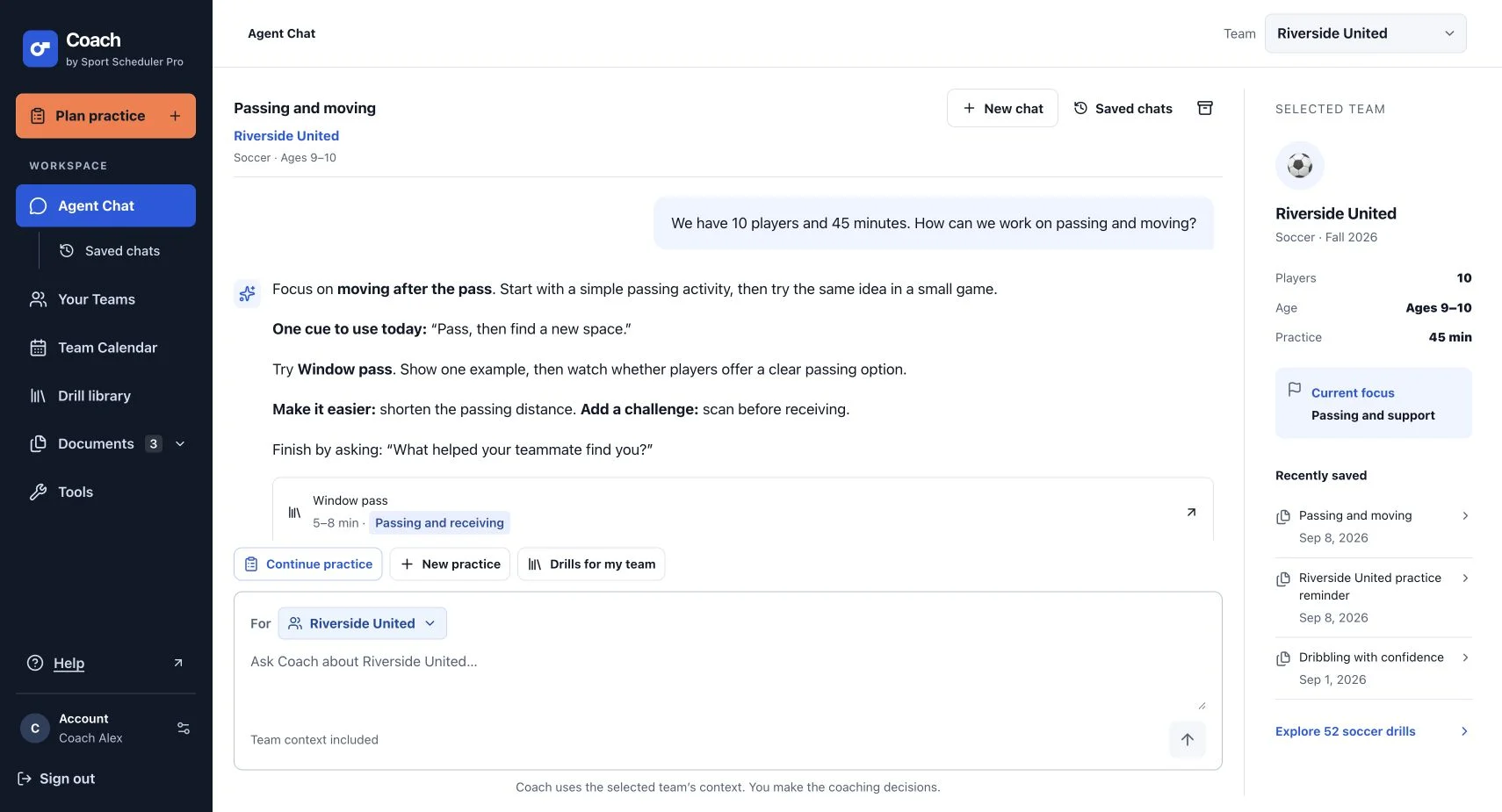
See Agent Chat, drill references, editable practices, your team calendar and messages to parents in a short narrated walkthrough.
Recorded with a sample team and demonstration responses. Review activities and plans for your players before using them.
YOUR TEAM. YOUR DECISIONS.
Turn an idea into
your next practice.
Set your team’s ages, headcount and goal, then review and adjust the plan with Coach.
- 01
Plan for the players who can come
Use the expected headcount, available equipment and actual practice length. Pick one focus the group agrees is worth practicing, whether that is passing support or communicating on a middle ball.
- 02
Start at a comfortable level
Choose an easier version first when experience varies. Shorten turns, offer rest and change one condition at a time; adult age alone does not imply a particular fitness or skill level.
- 03
Make the next meeting simple
Save a recurring practice, attach the plan and draft the team reminder. Reuse the useful parts next time and edit the activities when attendance changes.
COACH BY SPORT SCHEDULER PRO
One plan.
Your coaching essentials.
$19/ month
Cancel anytime
Get Coach500 AI requests per month across chats, practice plans and message drafts. Coach is a separate subscription from Sport Scheduler Pro.
- AI agent coaching help with your team’s context
- 675 sport drills and general workouts
- Quick reference and full drill instructions
- Editable, timed practice plans
- Multiple teams and joint practices
- Favorite drills and recorded usage
- Team Calendar with recurring events
- ICS and schedule CSV imports
- AI drafts for parents and players
- Unlisted sharing, PDF and Excel downloads
BEFORE YOUR NEXT PRACTICE
Adult recreational sports coaching questions
More on accounts, sharing and subscriptions in the Coach Help Center.
Is Coach suitable for adult beginners?
Yes. The library includes adult-age activities and simpler variations across supported sports. Start with tasks the group can perform comfortably. An adult age selection does not assess fitness, readiness or experience, so the coach or organizer still chooses the appropriate level.
Which sports can adult recreational teams use?
Coach supports soccer, basketball, baseball, softball, volleyball, flag football, tennis and pickleball, plus general movement activities. Check each drill’s age and group-size range when building a session.
Can I make a practice that lasts only 30 or 40 minutes?
Yes. Choose the practice length, focus on a few useful activities and edit the timings before saving. Keep time for setup changes, water and a brief check-in rather than filling every minute with a new drill.
What if attendance changes every week?
Update the expected headcount and review the group sizes in the plan. Some tasks work in pairs with a rotating observer; others need a specific active group. You can replace a drill, change the plan or draft a new one for the people attending.
Can I share a recurring calendar with the team?
Yes. Team Calendar supports recurring events and a shareable calendar link. The shared calendar is not indexed by search engines, but anyone with the link can open it. Review what it includes and use the available share controls when you need to update or revoke access.
SHOW UP READY