Coach by Sport Scheduler Pro
Your first soccer practice, planned for 60 minutes.
For eight players ages 8–10. Start with a small game, practice controlling and moving the ball, then return to play. Keep the focus simple: find space with the ball under control.
Build a free practice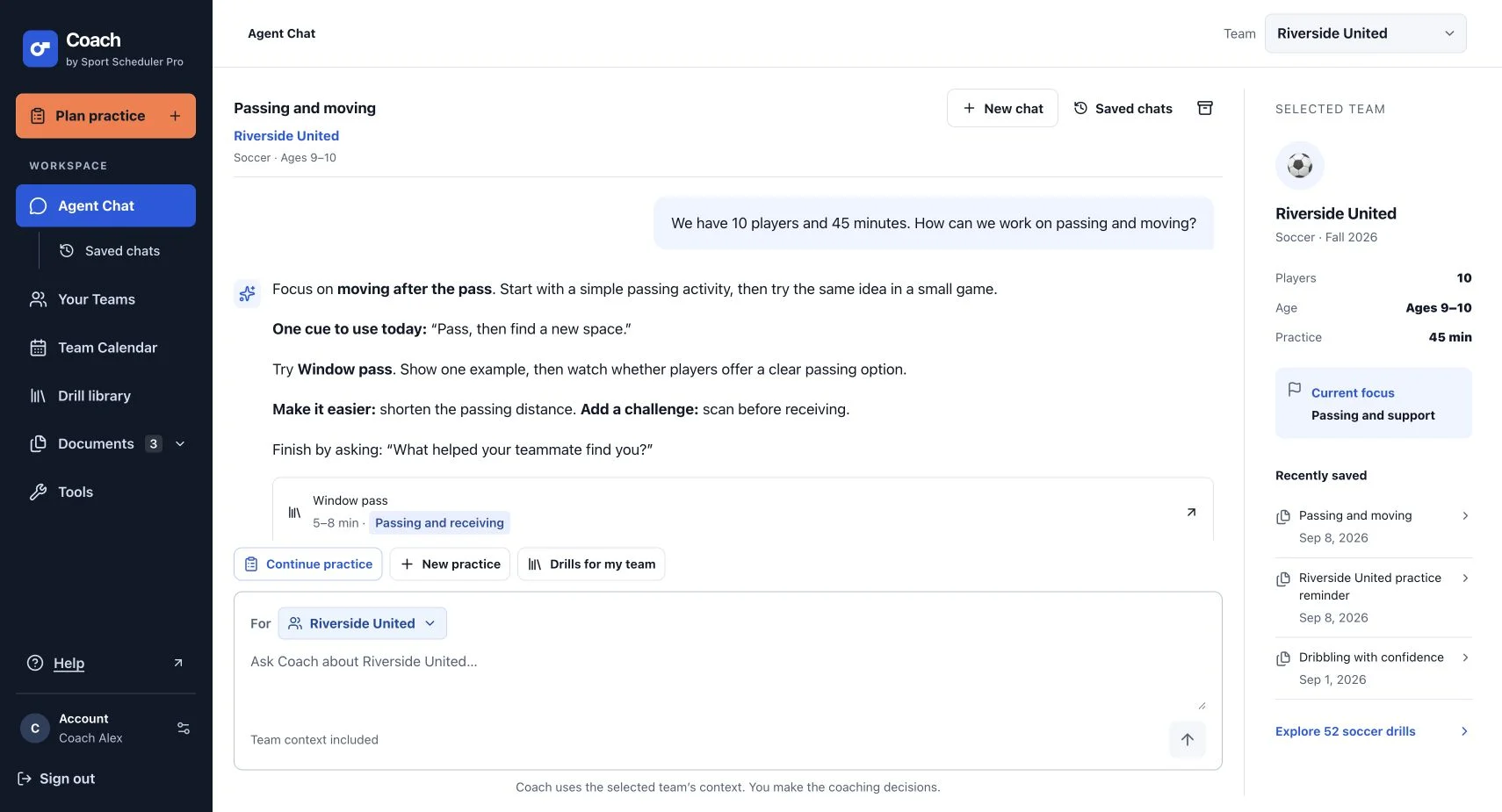
Before players arrive
Bring eight age-appropriate soccer balls and 24 cones or flat markers. Use a clear, level area with run-off space. Reuse markers between activities rather than leaving unused lanes inside the game area.
Show the stop signal, identify the water area and check footwear before starting. Keep the ball on the ground: these games use interception-only defending, without tackling, contact or heading.
Watch, then choose one cue
In the arrival game, notice whether players can control the ball and find an open route. Keep your next instruction tied to something you saw. In the final game, let players try the idea without stopping every play.
The session follows U.S. Soccer’s play-practice-play structure: use an opening game to observe, focused activities to practice, and a closing game to apply the learning.
Adjust the plan on the field
The timings include planned water and reset periods; pause sooner whenever needed. Shorten a drill that is no longer useful. If players need longer to settle the ball, keep the easier version and preserve time for the final game.
First practice: control the ball and find space
- 0–5minutes
Progressive walking warm-up
Walk the boundary together and show the stop signal.
How to run it
Players spread along a clear straight route or short visible loop with a separate return path.
- Begin at an easy walking pace with relaxed arms.
- Gradually choose a slightly more purposeful walk while staying comfortable.
- Return to the easier pace, then repeat only if the group feels ready.
- Pause together and check the space for the next activity.
Equipment: No portable equipment required
Keep it safe: Use a level, clear surface, comfortable movement and an optional rest at any time. Stop for pain, dizziness or unusual breathlessness; this is general activity, not rehabilitation or medical clearance. Match the challenge to demonstrated skill and comfort, not age alone. Offer shorter turns and rest; the listed age range does not establish fitness or readiness.
- 5–13minutes
Small-sided arrival game
Play 4v4. Observe ball control and movement before offering one cue.
How to run it
Make teams as even as possible and use a neutral helper for odd counts. For 11–12 split into one six-player field and one five- or six-player field. Mark a wide goal at each end; no goalkeepers. Use existing clear field markings for all boundaries and targets if flat markers are unavailable; choose another activity if the described layout cannot be made visible.
- Players begin a free game toward opposite goals.
- Allow dribbling, passing and controlled ground finishes; opponents cover open routes and intercept passes without tackling or blocking contact.
- Restart with a free pass from the side when the ball goes out, with opponents giving three yards.
- Coach observes involvement and choices; after several minutes offer one short question, then let play continue.
Equipment: 2 balls available; use 1 per active field; 4 flat markers per field; existing clear field markings may replace these; Optional team bibs
Keep it safe: No goalkeepers, contact or tackling; use adjacent fields only if the adult can supervise both clearly. Keep the ball on the ground; no heading or body contact. Use a clear, level area and pause for water or discomfort as needed. Leave spare balls and personal equipment outside all movement and shooting paths.
- 13–18minutes
Toe taps
A ball each; short sequences with pauses and resets.
How to run it
Give each player a ball and a personal space at least two arm-lengths from the next player, spread across the coach’s view. Everyone works in their own area; no line or odd-player rotation is needed. Pause after short attempts to demonstrate or rest. Begin with both feet on the ground and the ball just in front.
- Lift one foot, touch the top of the ball lightly with the sole near the toes, then return that foot to the ground.
- Repeat with the other foot. Keep the ball nearly still and keep your weight over the supporting foot.
- Try a short alternating sequence, pause and reset. If the ball escapes, stop nearby players before collecting it.
Equipment: 1 appropriate practice ball per player
Keep it safe: Never stand on or transfer body weight onto the ball. Keep the ball on the ground and stop if balance is uncertain. Leave room for a rolling ball; no aerial kicks, tackling or contact. Match the challenge to demonstrated skill and comfort, not age alone. Rest or choose the easier option whenever control deteriorates.
- 18–25minutes
Slalom dribbling
Use the marked lanes and return outside the active route.
How to run it
Make four separated lanes, each with four cones in a line about 2 metres apart and a clear outside return route. Divide players evenly between lanes, with at most four per lane. One player dribbles in each lane while the next rehearses small touches in a separate waiting box. Start the next turn only after the lane is clear; each player completes one trip before joining the end.
- Dribble around alternate sides of the cones using small inside- and outside-foot touches.
- Slow before each turn and keep the ball close enough to choose the next touch.
- Stop beyond the final cone and return by the outside path. On the next turn, begin on the other side.
Equipment: 1 appropriate practice ball per player; 16 cones
Keep it safe: Use a clear level surface and stop all nearby activity before retrieving a loose ball. Keep separate active and waiting areas. Do not add contact, speed contests or a forced repetition target. Match the challenge to demonstrated skill and comfort, not age alone. Rest or choose the easier option whenever control deteriorates.
- 25–27minutes
Water and reset
Offer water and set up four separated passing pairs.
- 27–35minutes
Gate passing
Use four pairs. Pass only when the receiver is ready.
How to run it
Partners stand 4–6 yards apart with a two-yard window halfway between. Use low flat markers or clear existing field markings for the window; do not use shoes or raised objects. An odd player forms a trio and changes with the passer after every pass. Use existing clear field markings for all boundaries and targets if flat markers are unavailable; choose another activity if the described layout cannot be made visible.
- Check that the receiver is ready.
- Pass along the ground through the window using the inside of the foot.
- The receiver cushions the ball, moves it into a comfortable spot and returns it.
- After a minute, agree whether to move closer or farther apart.
Equipment: 1 ball per pair available; groups of 3 or more share one active ball and leave spares outside the area; Optional 2 flat markers per pair; existing clear field markings may replace these
Keep it safe: Leave gaps between lanes; do not use hard or raised objects as targets. Keep the ball on the ground; no heading or body contact. Use a clear, level area and pause for water or discomfort as needed. Leave spare balls and personal equipment outside all movement and shooting paths. For mixed ages, form pairs by a comfortable passing distance and pace, not age alone. Use the easier entry point first; a player may stay there while another uses the optional progression. No contact or forced speed.
- 35–37minutes
Water and game setup
Clear the individual lanes and mark the end-line game.
- 37–47minutes
Dribble over the end line
Play 4v4 with interception-only defending and clear run-off space.
How to run it
Use 2v2 through 5v5 with a neutral helper for odd numbers. At 12, rotate two players every minute. The entire far end line is the scoring target; no goals are needed. Use existing clear field markings for all boundaries and targets if flat markers are unavailable; choose another activity if the described layout cannot be made visible.
- Teams pass or dribble toward opposite end lines.
- A point counts when a player crosses the far line with the ball within one comfortable step.
- Defenders may intercept passes and cover routes but cannot tackle the dribbler.
- The other team restarts freely from the end after a point.
Equipment: 1 ball; 4 flat markers; existing clear field markings may replace these; Optional team bibs
Keep it safe: Leave several yards clear beyond end lines; stop before contact, rather than blocking a carrier physically. Keep the ball on the ground; no heading or body contact. Use a clear, level area and pause for water or discomfort as needed. Leave spare balls and personal equipment outside all movement and shooting paths.
- 47–57minutes
Small-sided game with a personal focus
Each player chooses one action to try, such as a controlled turn into space.
How to run it
Use 2v2 through 5v5 with a neutral for odd numbers; at 12 rotate two players every minute. Set wide end goals. Offer three sample actions: look up once before passing, move after a pass, or use a controlled turn. Use existing clear field markings for all boundaries and targets if flat markers are unavailable; choose another activity if the described layout cannot be made visible.
- Each player privately or quietly chooses one action to try.
- Play for two minutes with ground passes and interception-only defending.
- Pause for 20 seconds so players tell a partner one attempt they remember.
- Play again, keeping or changing the personal action; success means making an attempt, not meeting a score quota.
Equipment: 1 ball; 4 flat markers; existing clear field markings may replace these
Keep it safe: No tackling or body contact; players may pass on speaking to the whole group. Keep the ball on the ground; no heading or body contact. Use a clear, level area and pause for water or discomfort as needed. Leave spare balls and personal equipment outside all movement and shooting paths.
- 57–60minutes
Easy walk and team check-in
Walk together, offer water and ask what helped players keep control.
See Coach in action.
From a coaching question to a practice you can share.
Recorded with a sample team and demonstration responses. Review activities and plans for your players before using them.
Questions coaches ask
What should I teach at the first soccer practice?
Establish the stop signal and safe boundaries, then observe players in a small game. This session focuses on controlling the ball and finding space. Use what you see to choose the next practice focus.
What if fewer or more than eight players attend?
Recheck every drill’s player range and available equipment. Pair activities may need a rotating third player. Adjust game teams and field size so everyone has an active role; do not add a second field unless you can supervise it.
Can I change this to a 45-minute practice?
Yes. Remove the five-minute toe-tap block and the ten-minute personal-focus game, leaving the end-line game as your finish. Keep the warm-up, water periods and check-in. Coach lets you edit blocks and timings in saved practice plans.
Coaching resources
Set the dates. Plan the practice.
Organizing the league too? Build your matchups with Sport Scheduler Pro, then use Coach to plan your team’s practice sessions.
Put your next practice in motion.
Save plans, manage teams and organize your season with Coach.
$19/month Cancel anytime